Techno-Economic Analysis for Early-Stage Biotech & FoodTech Startups: Introducing ScaleUpReady™

Updated: Aug 15
Over the past few months, I’ve been working on defining a techno-economic framework specifically designed for early-stage biotech and foodtech startups.
I decided to build this because I keep seeing the same pattern, again and again, across Europe, the UK, and globally.
Traditionally, techno-economic analysis (TEA) is performed only after pilot trials are completed and the full process has been validated. That approach makes sense. Conventional TEA requires extensive data inputs, detailed modeling, mass and energy balances, and solid engineering assumptions.
But when I speak with founders, 90% of the time they tell me the same thing:
“We don’t have enough data yet.”
“We’re not ready to run a TEA.”
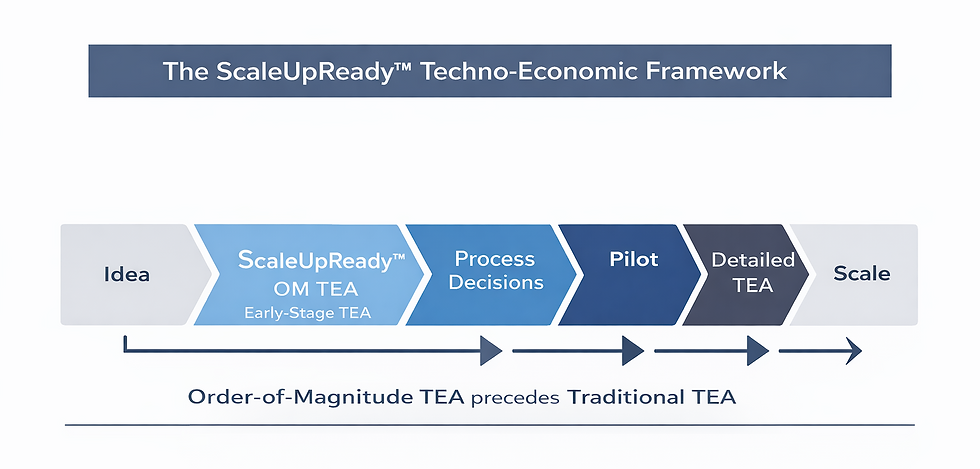
What many don’t realize is that you can perform an order-of-magnitude TEA right from idea conception. Even with incomplete data or missing processing steps, it is possible to generate directional insights that can shape process design, clarify capital needs, strengthen investor conversations, and dramatically reduce scale-up risk.
Most biotech and foodtech startups don’t fail because the science doesn’t work.
They fail because the economics were framed too late.
If you’re building a biotech or foodtech startup and wondering:
What will my cost per kg look like at scale?
How much capital do I really need to raise?
At what production volume do I become profitable?
When should I run a techno-economic analysis?
How do I calculate cost of production for a biotech startup?
What do biotech startup unit economics actually look like?
What is the real cost of precision fermentation at scale?
How much capital does a biotech startup truly need?
Then this framework was built for you.
The Pattern I Kept Seeing
Over 20+ years working in industrial scale-up, from pilot plants to demonstration facilities, including my time at the Centre for Process Innovation and collaborations across European bio-innovation research centres, I noticed something uncomfortable:
Startups don’t fail because of bad science.
They struggle because industrial decisions are made too late.
Or worse, without understanding their unit economics and scale-up implications early enough.
In biotech and foodtech startups, early technical decisions compound dramatically at scale. A fermentation titer, a downstream separation choice, or a facility capacity assumption can change capital intensity by millions.
And yet those decisions are often made without economic framing.
The Traditional TEA Problem
Techno-Economic Analysis (TEA) is typically:
Performed after extensive pilot campaigns
Modeled in detail at kinetic and stoichiometric levels
Built on full mass and energy balances
Supported by engineering teams
Taking months of development
Costing tens of thousands of dollars
That makes sense in large corporations or heavily funded startups.
But early-stage startups don’t operate like that.
Biotech and foodtech founders:
Don’t have perfect data
Don’t have months to wait
Don’t have unlimited runway
Must make irreversible decisions before Seed or Series A
And yet they are often told:
“Come back when you have more data.”
That’s backwards.
Because capital is being raised, pilots are being designed, and investor expectations are forming, with or without a structured techno-economic framework.
The Real Risk Is Not Having an Inaccurate Model
The Real Risk Is Being Blind
Most early-stage teams:
Optimize yields without defining a target cost
Design pilots without defining optimal commercial scale
Choose technology without defining cost sensitivity
Raise capital without defining total capital required to reach profitability
They move forward technically.
But economically, they’re flying blind.
And investors eventually see it.
When questions about cost at scale, capital intensity, or break-even volumes arise, hesitation erodes confidence.
An early-stage TEA is not about precision. It’s about clarity.

It’s not one or two times. It happens more often than most founders imagine.
Several startups have redesigned their entire process strategy after running an order-of-magnitude TEA.
In one case, a microbial production pathway was abandoned entirely. Once the economics were framed at scale, it became clear that the curernt pathay was extremely fragile. The team pivoted to a completely different biological pathway that offered stronger unit economics and lower scale-up risk.
In another case, alternative raw materials were identified early on to avoid hazardous waste streams that would have significantly increased compliance and disposal costs at commercial scale.
In a different situation, a startup initially rejected what they thought was an “expensive” downstream processing route. After modeling the full process holistically, the supposedly costly DSP step turned out to be economically justified, because it delivered superior quality and functional performance, allowing them to differentiate and command a stronger market position.
These were not technical failures.
They were economic revelations.
And in every case, the decisions were made before millions were committed.
The Moment It Became Clear
Repeatedly, I am brought in after:
A pilot had already been designed
A facility layout had already been assumed
A fermentation titer had already been locked in
Millions had already been committed
And then the uncomfortable conversations begin:
“At this scale, the waste management plant costs almost as much as production — and we didn’t consider it…”
“The business model doesn’t work at this capacity…”
“We can’t source enough raw materials…”
“Utility costs are far higher than expected…”
None of this had to do with the underlying technology.
It happened because industrial decisions weren’t framed economically early enough.
That’s when I realized:
Early-stage startups don’t just need a traditional TEA.
They need a decision framework for scale-up.
What ScaleUpReady™ Actually Is
ScaleUpReady™ is not just a spreadsheet.
It’s a structured framework for biotech and foodtech startups to integrate techno-economic analysis into their scale-up strategy from the earliest stages.
It helps founders:
Identify their scale-up readiness and data maturity
Determine the appropriate level of TEA
Define target price profiles
Work backward from market constraints
Stress-test scale assumptions
Map cost drivers before they become sunk costs
Align technical milestones with economic milestones
It allows founders to run a TEA even when:
Data is incomplete
Experiments are ongoing
Processing technologies have not been selected
Process steps are still evolving
Because uncertainty can be modeled.
Blindness cannot.
This Is Not a Rejection of Detailed TEA
I want to be very clear:
I am not minimizing the value of detailed, fully modeled techno-economic analysis.
Comprehensive TEA, with rigorous mass balances, process simulation, vendor quotes, and engineering validation, is essential before major capital deployment. It provides depth, defensibility, and precision.
ScaleUpReady™ does not replace that level of analysis.
It precedes it.
Its purpose is to make techno-economic thinking accessible to startups early enough so they can:
Become more confident in their process decisions
Strengthen their business case
Align technical development with economic reality
Prepare properly for detailed feasibility studies later
It bridges the gap between idea and full industrial design.
Why Biotech & FoodTech Specifically?
Because these sectors are uniquely exposed to scale-up risk:
High capital intensity
Ambitious technical milestones
Long development cycles
Fermentation scale risk
Downstream processing uncertainty
Regulatory friction
Volatile feedstock pricing
A wrong industrial assumption in an early-stage precision fermentation startup can cost its future.
Unit economics determine survival.
Capital intensity determines how much funding you must realistically raise.
Understanding both early is not optional, it’s strategic.
The Framework Was Built for Early-Stage Startup Reality
ScaleUpReady™ acknowledges:
You will have incomplete or imperfect data
You must still make industrial decisions
Investors expect economic clarity
Scale is not linear
Unit economics determine survival
Knowing total fundraise requirements is crucial
It structures decision-making under uncertainty, instead of waiting for certainty.

Why I Personally Care About This
Because I’ve seen:
Incredible technologies stall
Founders burn out
Investors lose confidence
Regions miss industrial opportunity
And I’ve also seen the opposite.
When economics are framed early:
Founder and investor confidence increases. Technical development becomes sharper. Fundraising becomes clearer. Scale-up becomes intentional rather than reactive.
That shift changes startup trajectories.
ScaleUpReady™ Is About Industrial Maturity — Early
Not about building a perfect model.
But about asking the right techno-economic questions at the right time.
Before:
You build the wrong pilot
You lock in a process without understanding unit economics
You pitch the wrong production capacity
You sign the wrong equipment contract
You raise capital on unrealistic assumptions
Final Thought
The biggest risk in industrial biotech is not technical failure.
It’s economic misalignment.
ScaleUpReady™ was born to close that gap.
If you’re unsure whether you’re ready for a full TEA, start with a ScaleUpReadiness Assessment.
Or book a 30-minute call to clarify your economic blind spots.
Gustavo Valente
Director, Sustech Innovation


Comments